

CISCO report on global networking trends for 2021. Workforce and Workplace.
Enterprise resilience special edition: see the five trends driving agility and resilience in times of disruption. Trends:
- Workforce: extend security to a remote workforce.
- Workplace: allow safe return to local workspaces.
- Workload: facilitate multicloud for greater resilience.
- Operations – Automation of operations for faster recovery.
- Operations: Leveraging AI-driven network analytics for smarter insights.
We have broken down the report into two blogs. In this first part, we will introduce the concept of resilience, leading to the concept of Business Resilience Networks, and address trends #1 and #2.
Trend No. 1: workforce: extending security to a remote workforce.
Trend No. 2: Workplace: enabling safe return to local workspaces.
Introduction: from business continuity to business resilience
Neither as individuals nor as companies were we prepared for a long-term global disruption like COVID-19. Virtually overnight, the entire workforce began working remotely, while some companies rushed to push their goods and services online and others shifted strategic supply chains to new suppliers and geographies.
Understandably, the pandemic has been a wake-up call for all nations, municipalities and organizations. But what has changed? After all, it’s not the first situation companies have faced; 7 out of 10 organizations experienced at least one severe crisis in the last 5 years and 95% are convinced it won’t be the last.
Human-caused disruptions such as cyber attacks, regulatory mandates and social unrest have become an increasingly common part of our environment.
Successfully addressing future disruptions requires IT leaders to adopt a new mindset. A renewed, agility-based mindset to achieve business resilience, rather than the more prescriptive and reactive approach that has been the foundation of traditional business planning. Unlike current business continuity efforts, business resilience positions organizations to prepare for even the unexpected.
Business continuity vs. business resilience
We will begin by defining the concepts.
Business continuity: the ability of an organization to continue the delivery of products or services at acceptable predefined levels after an interruption.
Business resilience: the ability of an organization to absorb and adapt in a changing environment to enable it to meet its objectives and to survive and prosper.
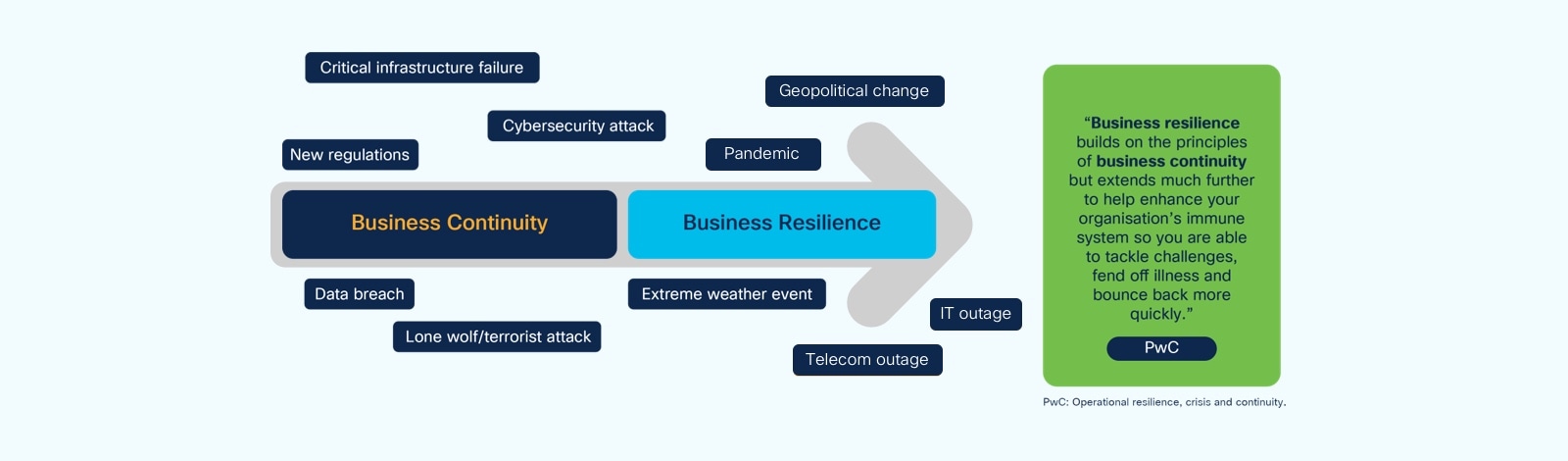
Business processes rely on an increasingly complex network of digital technologies that provide the foundation for achieving organizational resilience.
The network plays a central role in helping organizations build resilience, as the single platform that unites, protects and enables an increasingly dynamic and distributed set of users, devices, applications and workloads that are increasingly disaggregated and dispersed.
In other words, network resilience that maintains network connectivity and uptime is no longer sufficient. Enterprises need the resiliency enabled by an advanced network platform that can respond quickly to any circumstance, enable new operating models and services, integrate with IT processes, and protect their employees, core business, customers and brand. In fact, this is the same advanced network needed to support digital transformation initiatives.
Network resilience vs. business resilience
Network resilience: the ability to provide and maintain an acceptable level of service in the face of failures and challenges to the normal operation of a given communications network, based on prepared facilities.
Business Resilience Networks: networks designed to enable organizations to respond quickly, securely, and effectively to expected or unexpected disruptions.
Generate agility and resilience for workforce, workplace, workload and operations.
CISCO chooses to highlight five trends that network leaders should consider as part of their efforts to support their organization’s resiliency plans. They relate to improving resilience in four key areas:
- workforce,
- workplace,
- workload and
- IT operations.

Contact us and we will solve your doubts.
Workforce: remote, secure
CISCO Network Trend #1: Workforce: Extending security to a remote workforce
Most organizations are realizing that new and more flexible work approaches will become a permanent reality for their employees.
As a result, IT faces a new set of business requirements:
- Empowering workers to be productive and collaborative from any location
- Optimizing IT performance, cost and security for every worker
- Extending enterprise-class IT resources into the home
We well know that meeting these requirements has its own challenges. In particular, remote worker security, as well as end-user behavior, remain ongoing concerns and challenges for most IT organizations.
Top 4 IT challenges to enable remote workers:
- Security (65%)
- End-user behavior (52%)
- Application performance (43%)
- IT Operations (35%)
When using personal devices and connections to access corporate applications and data, remote workers are particularly vulnerable to cybersecurity attacks. Many bypass the VPN and connect directly to services and applications in the public cloud, which remains the most difficult environment to defend.
Network considerations: To enable secure remote work models, IT teams should adopt some or all of the following approaches:
- Scale VPNs to protect remote workers: Enterprise VPNs continue to offer one of the most effective and fastest ways to extend enterprise-level control and protection to remote workers.
- Use multi-factor authentication (MFA) to protect applications: MFA, which verifies the identity of each user before allowing them on the network or access to sensitive applications and data, is critical to protecting the organization.
- Deploy a Secure Access Services Edge (SASE) to help ensure protection for multicloud access: Cloud-based security and SASE help defend against Internet-based threats regardless of connection, user device or cloud environment.
Workplace: safe, reliable
Cisco Network Trend #2: Workplace: enabling safe return to local workspaces
While many questions remain, it is clear that workplaces and workspaces will evolve in the wake of the current pandemic. Countless companies are in the process of leveraging existing services, such as video conferencing and location-based Wi-Fi. Others are implementing new services and protections, such as physical distance monitoring, proximity reporting, increased workplace automation, and even robots that support human productivity and communication.
How do networking teams prepare for a safe return to the workplace?
- 62% are implementing more widespread videoconferencing.
- 38% are implementing social density knowledge to ensure safe working conditions.
- 36% focus on remote NetOps and help desk.
- 32% are implementing proximity reporting to maintain social distancing.
- Thirty percent are implementing new workplace safety measures, such as thermal cameras, advanced air filtration and non-contact elevator controls.
Source: “Cisco Enterprise Resiliency Networking 2020 Survey”.
Network considerations: A modern and agile network is a key driver that facilitates the safe and smooth reintroduction of workers into the facility.
Automate secure identity-based access: Organizations need the ability to consistently manage, protect and segment user and device onboarding and access to services, whether connecting from local, home or public networks.
Improve employee and customer safety through location-based analytics – Enable monitoring, alerts and workplace information to help protect the health and safety of employees, partners, guests and customers by leveraging existing Wi-Fi networks.
Conclusion: improving business resilience with an advanced network platform
As a conclusion, comment that disruptive events will continue to challenge us and our networks throughout our careers. It is time to rethink how your network strategy enables your business resiliency strategy and prioritize the new network capabilities most needed to stay ahead of the next big breakthrough.
The automation and AI-enabled insights offered by intent-based networks provide a robust platform to help you adapt to any circumstance. On the one hand they offer the agility, security, and on the other intelligence and speed needed to support resilience for:
Workforce: provide workers with a secure, enterprise-class environment and access to their applications while working from home, the office and anywhere in between.
Workplace: enable employees to safely return to the office with Wi-Fi enabled monitoring, alerts and reporting.
https://www.cisco.com/c/dam/en/us/solutions/enterprise-networks/2021-networking-report.pdf


