

CISCO has once again made a series of predictions on the technology trends that the company considers particularly relevant or significant for 2020:
The internet of the future
- The Internet of the future. Digital transformation will create multiple experiences in the coming years with advanced technologies such as virtual and augmented reality, 16K streaming, AI, 5G, quantum computing, adaptive cybersecurity, intelligent IoT and others yet to be invented. These future generations of applications require capabilities that the current Internet infrastructure cannot feasibly support. The Internet infrastructure must be rethought and reinvented to make the Internet faster, more scalable, more secure, cheaper and easier to manage. Cisco recently announced its strategy for building the Internet of the future, based on innovations in processors, optics and intelligent software.
Digital applications
- Digital applications, new brand loyalty. The digital interaction of users and consumers with businesses -through apps or websites- is now commonplace. According to the latest Cisco App Attention Index, the use of digital services has evolved into an unconscious behavior, a ‘digital reflex’. The majority of respondents (71%) admit that digital services are intrinsic to their daily lives. These users demand a ‘premium’ experience from businesses. In the event of performance issues with applications, they will turn to competitors (49%) or advise others against the service or brand (63%). From 2020 onwards, businesses must deliver simple, fast and innovative digital experiences, with a focus on real-time application performance data analytics.
Zero Trust and Threat Hunting
- Zero Trust and Threat Hunting. Cybercrime already costs economies three times more than natural disasters on a global scale. Reactive security, which primarily addresses threats only when they affect systems, is no longer sufficient. Organizations are demanding a new ‘Zero Trust’ approach (zero trust outside the network perimeter). In addition, the Threat Hunting model will play a more important role in the holistic security strategy of organizations. Threat Hunting aims to discover new, as yet unknown vulnerabilities and malware. Even if it does not detect malware, it will often uncover vulnerabilities that require new policies, thus reducing attack vectors.
Intent-Based Networking, beyond SDN
- Intent-Based Networking, beyond SDN. Beyond connectivity, networks play a fundamental role in the reinvention of applications, data protection, infrastructure transformation and work tools. In recent years, they have evolved around SDN (Software-Defined Networking) by facilitating centralized management and security, greater flexibility and lower costs. SDN is a relevant bridge to true Intent-Based Networking (IBN), systems that use artificial intelligence and machine learning to anticipate actions, detect and resolve anomalies and stop cyber-threats automatically. 78% of ICT managers surveyed by Cisco foresee this evolution in the next two years, while 35% believe that their networks will be fully intent-based by 2022.
Don’t hesitate, ask us!
Learn what you can do, and be prepared, for what’s to come in networking technology, operations and talent.
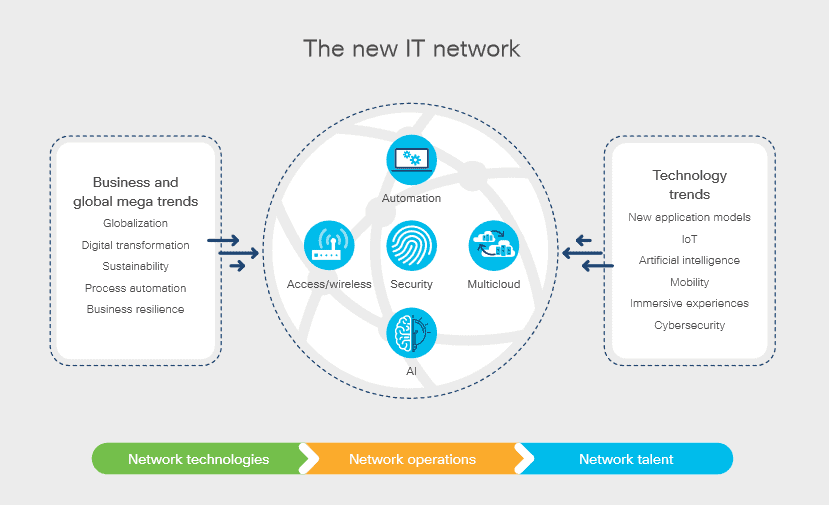
In today’s article we are going to focus on the first block, the “Network Technologies” part.
Several important network technology developments are coming together to form the basis of a new network model. Advances in five specific technology areas.
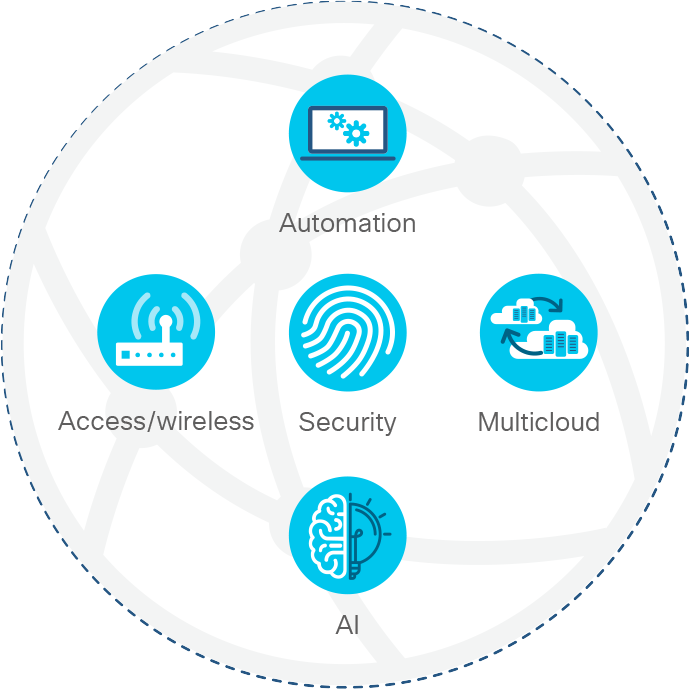
Five technologies that are shaping the new network.
- Automation: The intent-based network model expands beyond the automation capabilities of a traditional software-defined network (SDN) to align the network with changing business needs, application demands and policy requirements.
- Artificial Intelligence (AI): Networks are supporting explosive growth in traffic volume, connected mobile and IoT devices, and interconnected applications and microservices. Today’s networks are also generating massive amounts of data that exceed the ability of human operators to manage, much less understand, in a timely manner.
- Multi-cloud networks: IT teams must ensure operational consistency as applications, workloads, services, and data become more distributed throughout the edge cloud continuum.
- Wireless: The combination of 5G and Wi-Fi 6 will deliver on the promise of a seamless, high-quality user experience in private and public areas, both indoors and outdoors.
- Network security: The adoption of mobile, multicloud and IoT technologies is creating new security challenges.
These 5 technologies promise to drive the biggest wave of network transformation seen in decades. They will support market needs for greater scale, agility and security and, in doing so, enable the emerging trends that are changing the world as we know it.
Related news:
https://www.solutel.com/recomendaciones-basicas-para-minimizar-el-ransomware/
https://www.cisco.com/c/es_es/index.html
https://news-blogs.cisco.com/emear/es/2020/01/13/tendencias-tecnologicas-para-2020/


